Did You Know?
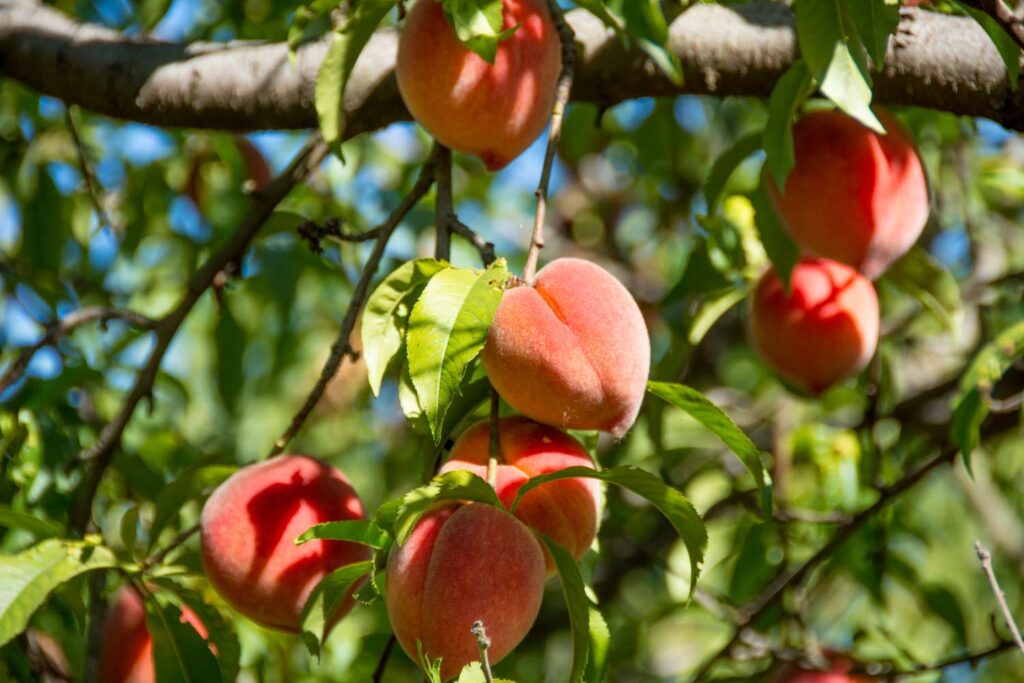
Peaches (Prunus persica) are in the stone fruit family which includes the cherry, apricot, almond, and plum. All these fruits are in the larger rose family which also includes apples, pears, quince, strawberries and blackberries. Nectarines are genetically a peach that lacks the trait that produces the fuzz on the skin. Peaches have been in cultivation since at least 6000BC starting in China. Peaches are self-fertile so a single tree will produce fruit without another variety nearby.
Types of Peaches
There are hundreds of different peach varieties with a host of different characteristics. Peaches can be freestone or cling stone depending on how easily the flesh separates from the stone. The flesh can be white, yellow or have red coloration. Varieties can have different levels of tartness from sub acid to full tartness. The firmness of the ripe fruit can vary from melting flesh to firm. The shape of the fruit can vary from the classic peach shape to a flattened donut shape. Some varieties of peach have very showy flowers while others have rather plain (but still pretty) flowers. One of the most critical characteristic of different peach varieties is their chill hour requirement – that is the amount of winter chilling required to flower and fruit the following season. Low chill varieties require as little as 150 hours while high chill varieties require 1000 hours or more. A variety that has too low a chill requirement for the area may flower too early and be damaged by freezing while a variety with too high a chill requirement may not flower and fruit at all. Our area averages around 600 chill hours and recommended varieties are usually in the 400 to 600 range. All peaches tend to try to set too many fruit and should be thinned heavily – often by removing 80% or more of the flowers and immature fruit to space fruit at 6 to 8 inches.
When to Plant
Peach trees are best planted when dormant – late fall through winter – so they can settle in and grow some roots before the demands of summer arrive. Trees can be bought bare root or potted. The potted trees can be planted as late as early spring. Named peach varieties will be grafted onto a root stock to get predictable characteristics. Trees grown from seeds will not match the parent variety. That said, a tree grown from seed may produce good fruit. There are areas in Texas where peaches have “naturalized” and produce trees from fallen fruit. My father-in-law had several volunteer peach trees in his yard where squirrels had eaten the fruit and buried the stone much like they do with pecans. He got a fair harvest of small peaches most years from these trees. For those interested, peaches do graft easily, so if you have a (non-patented) variety that you like, you can propagate it. In general, peach trees are short lived – 15 years or less with most in our orchard seldom reaching 10 years.
Harvest and Storage
Peaches are a climacteric fruit – that is they will continue to ripen after being picked so they can be picked while full sized but still firm and allowed to ripen indoors. The absolute best flavor will be from peaches that are fully ripened on the tree, beginning to soften and smell delicious. Fully ripe peaches have a short shelf life and should be consumed within a day or so. Ripening can be slowed somewhat by refrigerating. Peaches can be canned or frozen for longer term storage.
By: Michael Vidrine

Fresh Peach Chutney
Ingredients
- 3 Texas Peaches
- 2 cups white balsamic vinegar
- 2 cups brown sugar
- 2 tbsp fresh chopped garlic
- 1 cinnamon stick
- 2-3 bay leaves
- 1 red bell pepper small dice
- 1 yellow onion small dice
- 1/2 cup Messina Hof Semillon
- 1 bunch green onions sliced on bias
- salt and pepper to taste
Instructions
- To start, get a pot of boiling water going
- Make a small x in the bottom of each peach, drop your peaches in the boiling water for 2-3 minutes
- Carefully remove from the water and transfer to an ice bath. This will allow the skins to peel easily
- While the peaches cool, take a non-reactive pot and place the vinegar/sugar/garlic/ginger/cinnamon and bay leaves in the pot
- You are going to cook this to a syrup 30- 45 minutes before it hits a syrup consistency, it helps to have a cover on your pot too, so sugar crystals don’t form (the steam washes the sides down)
- While this is reducing, you want to peel and de pit your peaches
- Dice them into about ½ inch cubes
- Once your syrup is cooked down, add your peppers and onions. The water in the vegetables will thin your syrup so cook them for 10-15 minutes on medium heat.
- Shut off the heat and add your peaches, Semillon, green onions, salt and pepper
- The heat of the syrup will continue to cook the peaches
- Cool and transfer to glass jars to store in your fridge
- This chutney goes with everything, fish/pork/game/chicken, you can pour it over a chuck of cream cheese and eat it with crackers
- Enjoy!
5 Tips for Wine Pairings with Fresh Peaches:
- Fresh peaches have stone flavors that complement wines with similar flavors and with wines with herbal and mineral flavors that complement peaches.
- Ripe peaches are very ripe and juicy with strong flavor weight. They do best with a wine that has some sweetness like Riesling or Chenin Blanc.
- Cooking down of the peaches turns the fruit into sweet and sticky sauce that is luscious to spread onto bread, meats, and cheeses and needs wine with a strong flavor weight like the Sparkling Rose’
- White peaches and firmer less ripe peaches go well with drier wines that share hints of the stone fruit flavor like Sparkling wines or Rose’.
- Adding savory herbs and spices or rich meats in the dish pair well with red wines like our Bonarrigo Heritage Red
- Recommended wines: